New gives you warranty and peace of mind. Used saves real money — if you know where to look and what to avoid. Here's how to make the right call on a side-by-side in Utah, whether you buy new or used.
D&P Performance
1 month ago
You want a UTV. You've been looking at listings, scrolling through inventory pages, maybe even watching walk-around videos at midnight. And somewhere in that process, the question lands: do you buy new, or can you save real money buying used?
The honest answer is that both can be the right call — but they're different decisions with different risks. A new side-by-side gives you factory warranty, zero miles, and the peace of mind that comes with knowing exactly how a machine has been treated (because nobody has treated it yet). A used UTV can save you thousands, but only if the previous owner didn't defer maintenance, hide damage, or ride it like they hated it.
We've been selling and servicing UTVs at D&P Performance in Cedar City since 1978. In 48 years, we've seen every version of this decision play out — the buyer who saved $8,000 on a used machine and rode it for five trouble-free years, and the buyer who saved $6,000 and spent $5,000 of it on repairs in the first season. The difference almost always comes down to what was inspected before the money changed hands, and where the machine was purchased.
Here's what we know about buying a UTV in Utah — new or used — and how to make the right call for your situation.
The Case for Buying New
New UTVs on the lot at D&P Performance in Cedar City. Factory warranty, zero miles, and a service department ten minutes away when you need it.
A new UTV isn't just a machine with zero miles — it's a machine with a known history, factory backing, and a complete warranty that covers you if something goes wrong through no fault of your own. Here's what you get when you buy new:
Full manufacturer warranty. BRP covers new Can-Am UTVs with a factory warranty that protects against defects in materials and workmanship. If something fails that shouldn't have failed, it's covered — parts and labor, at no cost to you. That's not something you get with a used machine from a private seller.
Zero deferred maintenance. Every fluid is fresh, every belt is new, every bearing is tight. You're starting from a clean baseline, which means the maintenance schedule you follow is the only one that matters.
Current technology. Newer model years get refinements — better suspension tuning, improved CVT calibration, updated electronics, and sometimes entirely new platforms. The 2026 and 2027 Can-Am lineup reflects years of iteration that older models don't have.
Manufacturer financing. BRP regularly runs promotional financing rates through authorized dealers. Qualified buyers can often secure rates between 0.99% and 3.99% APR — rates that are rarely available on used machines. Ask our finance team about current promotions.
Choice of model and configuration. When you buy new, you pick the exact model, trim, and color you want. Used inventory is whatever happens to be available.
The Downsides of New
New isn't perfect. The two biggest factors working against it:
Depreciation. A new UTV loses the largest chunk of its value in year one — typically 15–25% depending on the model. A $28,000 side-by-side might be worth $21,000–$24,000 after one season and 1,500 miles. If you plan to keep the machine for five or more years, depreciation matters less. If you trade every two years, you're eating that first-year drop every time.
Higher purchase price. Obviously. A new Can-Am Maverick X3 starts around $24,000 and tops $35,000 for the highest trims. The same machine two years old with reasonable miles might be $18,000–$24,000. That's real money.
The Case for Buying Used
A used UTV for sale in Utah isn't hard to find — the state has one of the highest per-capita OHV ownership rates in the country, and machines turn over regularly as riders upgrade, downsize, or move on from the sport. The used market is active, and the savings are real.
Where the Savings Are
The sweet spot for a used side-by-side is typically two to four years old with 1,500 to 5,000 miles. At that age, the steepest depreciation has already happened, but the machine still has plenty of life in it if it was maintained. Here's what the math looks like:
Used utility (Can-Am Defender, 2–3 years old, 2,000–4,000 mi): $10,000–$16,000, down from $15,000–$20,000 new
Used mid-range sport (Can-Am Commander, 2–3 years old): $13,000–$18,000, down from $18,000–$24,000 new
Used full sport (Can-Am Maverick X3, 2–3 years old): $18,000–$24,000, down from $24,000–$32,000 new
That's a savings of $5,000 to $10,000 depending on the model. Enough to cover a trailer, a full season of gear, and your first year of maintenance — or just stay in your pocket.
The Risk of Used
Here's where it gets honest: a used UTV is only a good deal if the machine is in good condition. And unlike a used car — where a Carfax report and a pre-purchase inspection are standard practice — UTVs often change hands with no service records, no disclosure of damage, and a lot of optimistic descriptions that don't hold up under scrutiny.
The machines that cost the most after purchase are the ones with:
Deferred maintenance. Skipped oil changes, a CVT belt that should have been replaced two riding seasons ago, differential fluid that's never been touched. These aren't cosmetic issues — they're compounding damage that gets more expensive the longer it goes.
Undisclosed damage. A bent A-arm that was straightened instead of replaced. A frame that was cracked and welded. Electrical gremlins from a submerged water crossing that "wasn't that deep." Private sellers aren't required to disclose these things, and some won't.
Desert and sand abuse. Southern Utah riding is demanding. Sand grinds into bearings, dust packs into radiators, and heat cycles stress every fluid in the machine. A used Can-Am that spent its life running hard at Sand Hollow or Sand Mountain has lived a different life than one that did gentle trail rides at Duck Creek.
What to Inspect on a Used UTV
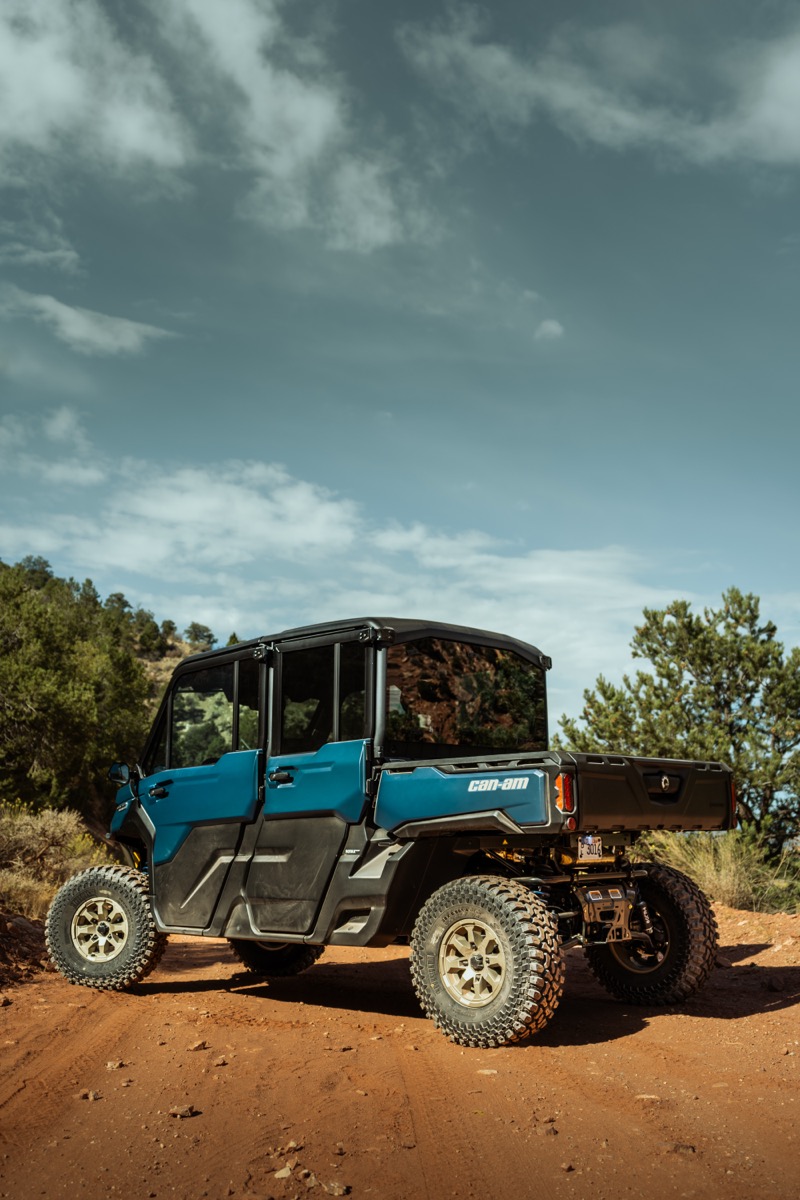
A well-maintained Defender on a Southern Utah trail. The condition of a used UTV tells you more than the price does — know what to look for before you hand over cash.
Whether you're buying from a dealer or a private party, these are the checks that separate a good used UTV from a money pit. If you're not comfortable doing these yourself, bring someone who is — or have a dealer like D&P Performance inspect it before you buy.
The CVT Belt and Clutch
Pull the belt cover and look at the belt. A healthy belt has consistent texture on the contact surfaces, clean edges with no fraying, and no visible cracks. A belt that's glazed (shiny and smooth on the sides), cracking, or showing cord is on borrowed time. While the cover is off, look at the clutch sheave faces — scoring or discoloration indicates heat damage or contamination. This is the single most telling inspection point on any used UTV.
Fluids
Pull the engine oil dipstick. Clean oil at the correct level means someone cared enough to maintain the machine. Dark, gritty oil or oil that's low tells you the maintenance schedule was treated as a suggestion. Check the coolant — it should be clean, not rusty, milky, or oily. Milky coolant can indicate a head gasket issue, which is an expensive problem on any engine.
Wheel Bearings and Suspension
Grab each tire at the 12 and 6 o'clock positions and push in and out. Any clunking or play means the wheel bearings are worn — a common issue on machines with sand and dust exposure. Check the ball joints and tie rod ends by grabbing them and checking for looseness. Inspect the A-arm bushings for cracking or deformation. These components are safety-critical and not cheap to replace across all four corners.
Frame and Skid Plates
Get under the machine. Look at the frame rails and skid plates for dents, cracks, or signs of repair (grinding marks, fresh paint over bare metal, weld beads that aren't factory). Hard rock impacts can crack frames, and a cracked frame is often a total-loss repair.
Electrical System
Start the machine cold — a warm engine hides starting problems. Watch the dash for warning lights that stay on after startup. Test every light, turn signal (if street-legal), and accessory. Electrical problems are time-consuming and expensive to diagnose, and they're easy to hide when a machine is pre-warmed and staged for a showing.
Ask for Records
Service records from a dealer are the strongest evidence that a machine was maintained properly. Oil change receipts, belt replacement history, any warranty work — all of it matters. No records doesn't necessarily mean no maintenance, but it does mean you're taking the seller's word for it.
Dealer vs. Private Party: Where You Buy Matters
The price on a private-party listing is almost always lower than the same machine at a dealership. That's not a secret, and it's not a scam — it reflects a real difference in what you're getting.
Buying from a Dealer
Inspection: A reputable dealer inspects every used machine before it goes on the lot. At D&P Performance, our factory-trained technicians go through the machine the same way they'd service one — checking every system, replacing what needs replacing, and documenting the condition.
Accountability: A dealer has a physical location, a reputation, and a Google review page. If something goes wrong, you have recourse. You know where to find them.
Financing: Dealers can offer financing on used machines. Private sellers generally can't — it's cash, cashier's check, or figure it out yourself.
Trade-ins: If you're upgrading from an existing machine, a dealer handles the trade. We take trades from any manufacturer — Polaris, Honda, Kawasaki, Yamaha, whatever you're riding now.
Title and paperwork: A dealer ensures the title is clean, handles the transfer, and can assist with Utah OHV registration. Private-party title issues — liens, out-of-state titles, missing paperwork — are more common than you'd expect.
Buying from a Private Seller
Lower price: Typically $1,000–$3,000 less than a dealer for the same machine in the same condition.
As-is sale: No warranty, no recourse, no come-backs. Once the money changes hands, the machine is your problem.
Title risk: Always run the VIN before buying. Check for liens, verify the seller's name matches the title, and be wary of any story that explains why the title "isn't available right now."
No financing: You need the full amount at closing.
Inspection burden is on you: The seller has no obligation to disclose problems, and most listings emphasize the positives. Bring a mechanic, or accept the risk.
Utah-Specific Considerations
Southern Utah terrain is beautiful — and demanding. The red rock, sand, and heat that make this place incredible to ride also accelerate wear on every component. That context matters when evaluating a used UTV.
Buying a used UTV in Utah has a few considerations that don't apply everywhere:
OHV Registration
Every off-highway vehicle operated on public land in Utah needs a current OHV registration sticker ($30/year for trail use, $87.75+ for street-legal). When buying used, verify the machine has a clean Utah title or can be titled in Utah. Out-of-state machines need a VIN inspection before they can be registered. If the seller can't produce a title, walk away — no title means no legal registration, and no legal riding on public land.
Desert Wear Patterns
A used UTV from Southern Utah has lived in one of the harshest riding environments in the country. Fine red dust works into every bearing, seal, and joint. Sand abrades belt surfaces and clutch faces. Summer heat cycles stress coolant, oil, and electrical connections. A machine with 3,000 miles in the Southern Utah desert has worn differently than a machine with 3,000 miles on Pacific Northwest forest trails. Inspect accordingly.
Altitude and Turbo Considerations
If you're buying a turbocharged UTV (Maverick X3, Maverick R), keep in mind that Utah riding regularly takes these machines from 3,000 feet in St. George to 10,000+ feet at Brian Head. That altitude swing affects turbo boost management and engine tuning. A turbo machine with a check engine light or intermittent performance issues may have an altitude-related ECU problem — something a dealer with BRP diagnostic software (BUDS2) can identify quickly, but a private seller may not even be aware of.
The Warranty Factor
This is where the new-vs-used math gets interesting. A new Can-Am comes with a factory warranty that covers defects for a defined period. If a water pump fails, a wiring harness shorts, or an injector goes bad — it's covered. On a used machine outside warranty, that same failure is $500 to $2,000 out of your pocket.
Some manufacturers offer certified pre-owned programs or extended warranty options for used machines purchased through authorized dealers. Ask about availability — a few hundred dollars in extended coverage can save thousands if a major component fails in the first year of ownership.
The key point: warranty coverage is tied to authorized dealer service. If a machine was serviced at non-authorized shops or modified in ways that void the warranty, the coverage may not transfer even if the time or mileage is still within limits. One more reason to check service records and buy from a source you trust.
Making the Decision: A Framework
After 48 years of watching people make this decision, here's the framework that consistently leads to the right outcome:
Buy new if:
You want warranty protection and zero risk of inherited problems
You can take advantage of manufacturer financing promotions
You want a specific model, trim, or configuration
You plan to keep the machine for five or more years (depreciation matters less)
You don't want to worry about what the previous owner did or didn't do
Buy used if:
Your budget is firm and you need to stretch further
You can find a well-maintained machine with service records
You're buying from a dealer that inspects and stands behind used inventory
You're comfortable evaluating mechanical condition (or you bring someone who is)
You're okay with available inventory rather than a specific configuration
Don't buy used if:
There are no service records and the seller "just never kept them"
The price seems too good — it usually means something is wrong
You can't inspect the machine in person before paying
The title situation is anything other than clean and straightforward
Ready to Find Your UTV?
D&P Performance carries both new and pre-owned Can-Am UTVs — every machine inspected by factory-trained technicians, every sale backed by a service department that's been keeping Southern Utah riding since 1978. The Bulloch family's 169 race wins and 21 championships weren't built on cutting corners, and that same standard applies to every machine on our lot.
Whether you're leaning new or hunting for the right used side-by-side, browse current inventory or call (435) 586-5172 to talk through what's available. We're at 905 S Main St in Cedar City — closer to Brian Head, Duck Creek, and the northern trails than any other authorized Can-Am dealer in the region.
Contact us online if you'd rather start the conversation that way. No pressure, just honest answers from people who ride these machines and know them inside out.
Frequently Asked Questions
Is it better to buy a new or used UTV?
It depends on your budget, mechanical confidence, and how long you plan to keep the machine. A new UTV comes with a full factory warranty, zero wear, and current technology — but you pay full MSRP and absorb the steepest depreciation in year one. A used UTV can save 25–40% off the original price, but only if it was maintained properly. If you buy used, buy from a dealer that inspects and stands behind the machine, or bring a qualified mechanic to evaluate a private-party sale.
What should I check when buying a used UTV?
Start with the CVT belt and clutch — look for glazing, cracks, or fraying. Check the air filter for excessive dust contamination. Inspect all four wheel bearings for play. Examine suspension components — ball joints, tie rod ends, and A-arm bushings — for wear or damage. Check coolant condition (clean, not milky or rusty). Pull the dipstick and verify clean oil at the correct level. Get under the machine and inspect the frame and skid plates for impact damage. Start the machine cold and watch for warning lights that stay on.
Should I buy a used UTV from a dealer or a private seller?
Dealer purchases cost more upfront but provide real advantages: professional inspection, accountability, financing options, trade-in handling, and clean title transfer. Private-party sales are typically $1,000–$3,000 cheaper but are as-is with no warranty or recourse. If you go private party, always verify the VIN, check for liens, confirm the title is clean, and have the machine inspected by a qualified technician before paying.
Where can I find a used Can-Am UTV for sale in Utah?
D&P Performance in Cedar City carries both new and pre-owned Can-Am UTVs including Maverick X3, Maverick R, Commander, and Defender models. As a factory-authorized Can-Am dealer since 1978, every pre-owned machine is inspected by factory-trained technicians before it goes on the lot. D&P also accepts trade-ins from any manufacturer. Visit at 905 S Main St, Cedar City, UT 84720 or call (435) 586-5172 to ask about current used inventory.
How much does a used UTV cost in Utah?
Used UTV prices vary by model, age, condition, and mileage. A two- to three-year-old utility model like a Can-Am Defender with 2,000–4,000 miles typically sells for $10,000–$16,000 — roughly 25–35% less than original MSRP. Sport models hold value better: a two-year-old Maverick X3 with moderate miles might list for $18,000–$24,000 depending on trim. Always factor in any deferred maintenance costs when comparing a used price to new.
Tags:
Used UTV
New vs Used
Buying Guide
Side by Side
Can-Am
Cedar City
Southern Utah
UTV Shopping
Warranty
Dealer vs Private