How to Choose a Powersports Service Shop in Southern Utah
Pick the right powersports service shop in Southern Utah: questions to ask, red flags to avoid, and why all-brand factory service matters.
D&P Performance
4 months ago
Pick the right powersports service shop in Southern Utah: questions to ask, red flags to avoid, and why all-brand factory service matters.
D&P Performance
4 months ago
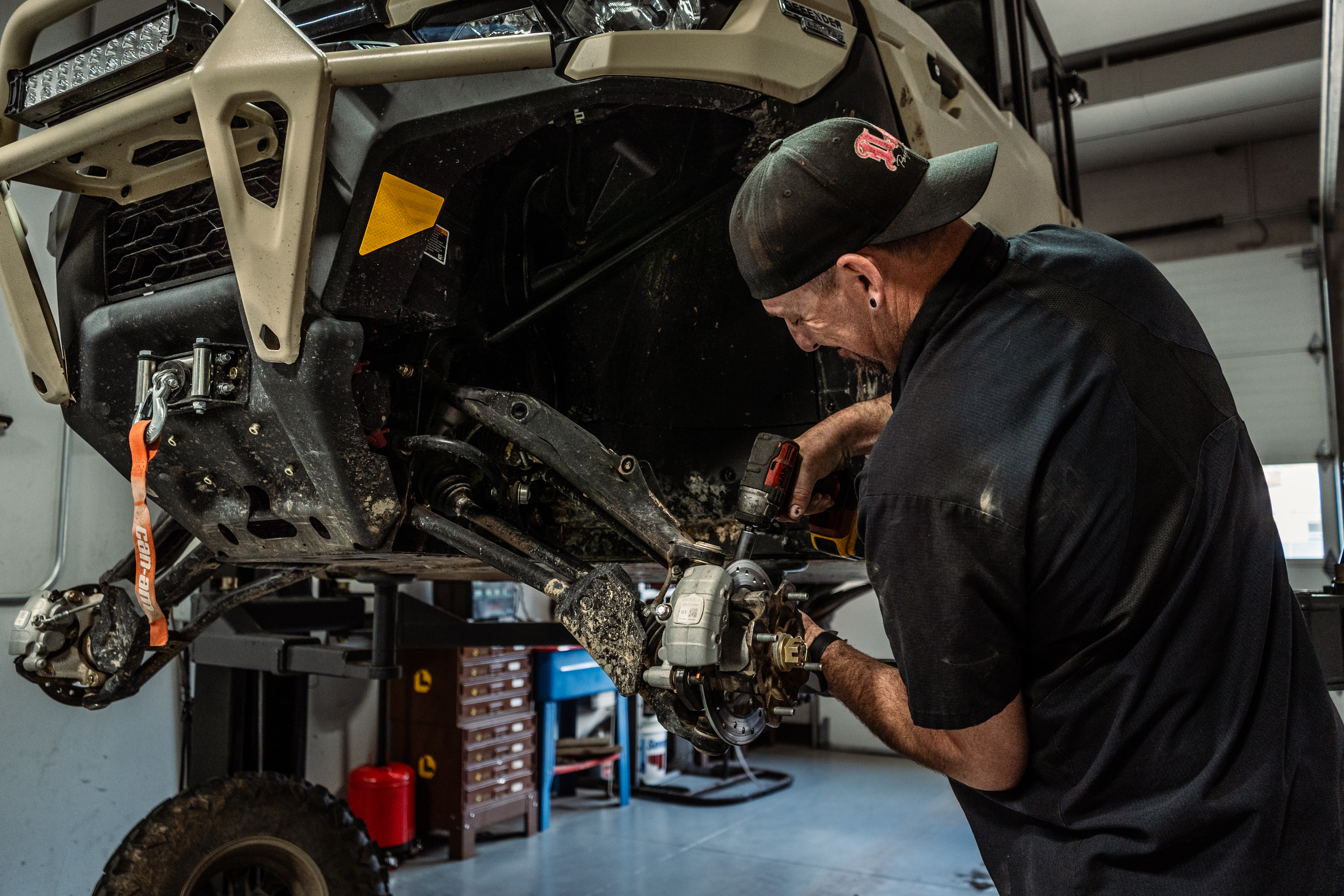
Your UTV or ATV is a serious investment. A new Can-Am Maverick, Polaris RZR, or Honda Talon can run $25,000 and up. Even a well-used machine is worth more than most daily-driver cars. So the question of who you trust with that investment matters — probably more than most riders think about until something goes wrong.
This post isn’t a sales pitch. It’s an honest breakdown of what separates a good powersports service shop from a bad one. Use these criteria to evaluate any shop in Southern Utah — including ours. If a shop comes up short on several of these points, keep looking. If it checks most of these boxes, you’ve probably found a good one.
Powersports service shops fall into two broad categories, and most riders don’t think about the difference until warranty day.
Factory-authorized dealers are certified by a manufacturer — Can-Am/BRP, Polaris, Honda, etc. — to sell, service, and perform warranty work on that brand. They receive factory technician training, access to manufacturer diagnostic software, and can order genuine OEM parts directly.
Independent shops aren’t tied to a manufacturer. Many are excellent — skilled, honest, and well-equipped. But they can’t perform factory warranty work, may not have the latest diagnostic software for newer machines, and sometimes use aftermarket parts where OEM would be more appropriate.
Here’s why the distinction matters to your wallet and your machine:
The ideal combination — and it’s rare — is a shop that holds factory authorization on the brands that require it but still services every other brand like a good independent would.
Call any shop you’re considering and ask these directly. How they answer tells you as much as what they answer.
Some warning signs are obvious. Others take experience to spot. These are the ones worth paying attention to.
No estimates, no ranges, no pricing conversation. “We’ll figure out the bill when we’re done” is not an acceptable business practice. A good shop can quote ranges for common work in minutes. Refusal to discuss pricing before starting work is the single most reliable predictor of an unpleasant bill.
Won’t identify the parts being installed. If you ask what belt or what fluid they’re putting in and get “a good one,” that’s a problem. You deserve to know if it’s OEM, what brand of aftermarket, and what it costs. Shops that stock bottom-tier parts depend on customers not asking.
Timelines that constantly shift with no communication. Delays happen — parts backorders, unexpected damage, real reasons. But shops that repeatedly push timelines without calling you are shops where your machine sits in a corner getting forgotten. Good communication during a delay is almost as important as hitting the original deadline.
Invoices with no detail. Your invoice should itemize parts, labor hours, and specific work performed. “Service — $650” is a charge, not an invoice. Detailed records also matter for resale — future buyers trust documented service history from a shop that actually lists what was done.
Here’s a scenario that plays out constantly around Cedar City. Someone buys a Polaris RZR, loves it, and has it serviced at a Polaris-focused shop for three years. Then they decide to upgrade to a Can-Am Maverick. Suddenly their trusted shop can’t work on the new machine. Or they find a screaming deal on a used Honda Talon and their shop won’t touch it.
A multi-brand shop keeps your options open. You can switch brands without switching shops. You can buy used without worrying about service availability. You can bring in a friend’s machine without apologizing for the badge on it. And there’s a less obvious benefit: technicians who work across multiple brands see how different manufacturers solve the same engineering problems, which makes them better diagnosticians across the board.
For a deep dive on what multi-brand service looks like in practice, see our post on servicing Polaris, Honda, Yamaha, and more.
This one is underrated. A shop where the team rides on their weekends is fundamentally different from a shop where the staff just shows up to turn wrenches.
Riders know what these machines are actually asked to do. They know how a belt behaves at 9,000 feet on Brian Head. They know how Sand Hollow sand gets into places it shouldn’t. They know the difference between a diagnostic code that matters and one that can wait. That lived experience shows up in faster diagnoses, better recommendations, and a deeper understanding of what your machine actually needs.
At D&P Performance, riding isn’t an afterthought — it’s foundational to everything we do. We’ve been family-owned in Cedar City since 1978, and our crew reflects that: factory-trained technicians who spend their own weekends on the same terrain you ride, from the climbs up Brian Head to the sand at Sand Hollow. That’s the whole point. It’s the difference between a tech who’s only read the service manual and one who knows how a machine actually behaves when you’re 20 miles deep on a trail. When the people working on your UTV ride hard themselves, it shows up in faster diagnoses, smarter recommendations, and work held to the standard they’d want on their own machines.
Ask any shop you’re considering: “Does your team actually ride?” The answer, and the enthusiasm behind it, tells you a lot about the kind of work they’ll do on your machine.
Cedar City riders have options if they’re willing to drive — St. George is about 52 miles south, with bigger metros even farther. But distant service costs you more than the shop bill: a full day lost for every drop-off and pickup, fuel and wear on your tow vehicle, no chance to talk through a problem face-to-face, and a shop that doesn’t know your local terrain. The “drive to the big city” logic made sense when Cedar City didn’t have strong local options. That’s not the situation anymore.
Star ratings are a starting point, not the whole picture. When evaluating a powersports shop, dig deeper than the average score.
We’re not going to claim we’re the only good shop in the region. There are solid independent mechanics in Southern Utah, and we respect them. What we will say is that we’ve built D&P Performance to check every box on this list: factory authorization on the brands that require it, all-brand service on everything else, written estimates, OEM parts, honest timelines, and a qualified crew of technicians and employees who actually ride.
Don’t take our word for it. Read our Google reviews — filter for service specifically, look at how we respond to feedback, and make your own call.
Ready to try us? Schedule online, call (435) 586-5172, or learn more about who we are on our about page. For the complete breakdown of what our service tiers include, read our Complete Guide to UTV & ATV Service in Cedar City.
Your machine deserves a shop that earns your trust. We’d like the chance to be that shop.
The best UTV mechanic for you is one that gives written estimates, services your brand, holds the right factory certifications, and communicates before doing extra work. D&P Performance has served Cedar City riders since 1978 with factory-trained technicians who work on all brands — not just the Can-Am and Ski-Doo lines we sell.
Ask for written estimates before any work, confirm which brands and certifications they hold, ask whether they use OEM or aftermarket parts, and check how they respond to negative Google reviews. A shop that’s transparent about pricing and parts before you commit is the strongest signal of trustworthiness.
Yes — especially if your machine is under warranty. Factory-authorized dealers can perform warranty work, have manufacturer diagnostic software, and receive recall and service-bulletin notifications. Non-authorized service can void portions of your warranty. The ideal shop holds factory authorization on the brands that require it while still servicing every other brand.
Usually not. Beyond the shop bill, a 50-plus-mile drive costs you a full day per drop-off and pickup, fuel and tow-vehicle wear, and service from a shop that doesn’t ride your local terrain. Cedar City now has factory-certified, all-brand service locally, which removes most reasons to make the drive.
Visit D&P Performance in Cedar City to see our full inventory of Can-Am, Ski-Doo, and Lynx vehicles.
We'll get back to you within 24 hours
Thank you for reaching out. Our team will get back to you shortly.